Loading...
PayIndia
UPI payment wallet for tourists
Concept
React NativeNode.jsPostgreSQLStripe
The Problem
India processed 13.89 billion UPI transactions worth $247 billion in December 2024 alone. Every merchant has a QR code. Foreign tourists can't use any of them.
10M+ international tourists are locked out of UPI. Cash is dying but tourists can't go digital. 54% of QR codes are P2P (personal), and tourist wallets are restricted to P2M only. A tourist scans a vendor's QR and it fails 54% of the time.
The Solution
PayIndia: a UPI-linked prepaid wallet designed specifically for foreign tourists. A prepaid wallet linked to international credit cards that provisions a temporary UPI ID, enabling seamless QR code payments across India.
Key Innovation
Video KYC (set up before landing), Instant Merchant Onboarding (convert failed P2P scans in 60s), and Buddy Pay (P2P fallback).
Visuals
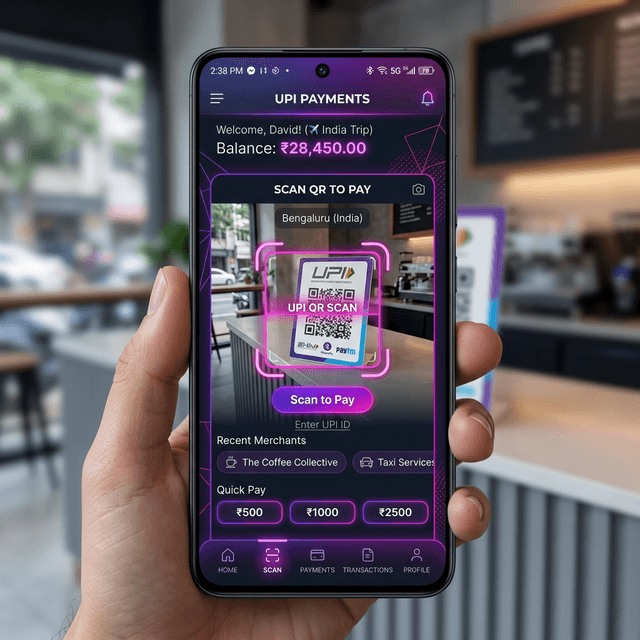
Key Innovations
PayIndia completely reimagines the onboarding flow to bring the onboarding time from 3 days to under 5 minutes, solving the "cold start" problem for tourists.
1
Video KYC
Self-serve passport verification and liveness check that tourists complete from their home country before boarding their flight to India.
2
Instant Merchant Onboarding
If a tourist scans a P2P QR code (54% of vendors), the vendor is sent an SMS to upgrade to a merchant account in 60 seconds. A compounding network effect.
3
Buddy Pay
P2P fallback via a network of verified local intermediaries when merchant onboarding isn't possible, ensuring the tourist is never left stranded.
Competitive Edge
Right now, tourists have to visit physical bank branches inside airports and queue for hours. PayIndia is 100% digital.
| Feature | PayIndia | CheqUPI | UPI One World | Alipay |
|---|---|---|---|---|
| Setup Location | Anywhere | Airport Kiosk | Bank Branch | App |
| Onboarding Time | <5 Mins | 30-60 Mins | 1-3 Days | Instantly |
| P2P Scan Fallback | Fails | Fails | N/A | |
| Load via Intl Credit Card | App Only | Cash/Forex Only | ||
| Acceptance in India | ~99% (UPI) | ~99% (UPI) | ~99% (UPI) | <1% |
$35B+
Capturable Digital Payment Volume
Targeting ₹73.5Cr ($8.8M) revenue in Year 3
Built With
React Native
Foundation
Node.js
Primary language
PostgreSQL
Key dependency
Stripe
Key dependency
NPCI APIs
Key dependency
Current Status
Concept
What's Next?
Scaling infrastructure and capturing user feedback to inform the next product iteration.